AI Fact-Checking Activities for High School Students
Help students test AI-generated claims instead of accepting polished answers at face value.
Use the ideas below as a starting point for your own classroom or school-team planning. Select the activities and supports that fit your students, program expectations, and institutional requirements.
Why verification needs to be taught explicitly
Students often encounter convincing sentences that contain incomplete, outdated, or invented details. Instead of treating an AI output as either entirely correct or entirely wrong, ask students to evaluate individual claims and identify what evidence would support them.
Activity 1: Claim, source, verdict
Give students a short, teacher-written AI-style response about a familiar topic. Ask them to underline three factual claims, locate an approved source for each, and mark the result as supported, contradicted, or not yet verified. A verdict of “not yet verified” is an acceptable evidence-based answer.
Activity 2: Find what is missing
Show a response that answers a question but overlooks a relevant perspective, date, location, or exception. Students identify what context is missing and rewrite the original question to request that context. They then explain why the revised answer would be more useful.
Activity 3: The citation check
Provide a response that refers to a named article, organization, or publication. Have students check whether the source exists, whether it actually supports the specific claim, and whether it is appropriate for the task. Do not assume that a plausible-looking citation is reliable.
A simple recording routine
Use four columns: AI claim; independently checked source; evidence found; decision and remaining uncertainty. Require students to write their reasoning rather than merely checking a box. A short exit ticket can ask which claim was hardest to verify and why.
Teach without requiring student accounts
The activities can be completed with paper examples and approved print or online references. Follow school privacy, account, accessibility, and academic-integrity policies. Never enter real student records, passwords, or sensitive personal information into unapproved AI tools.
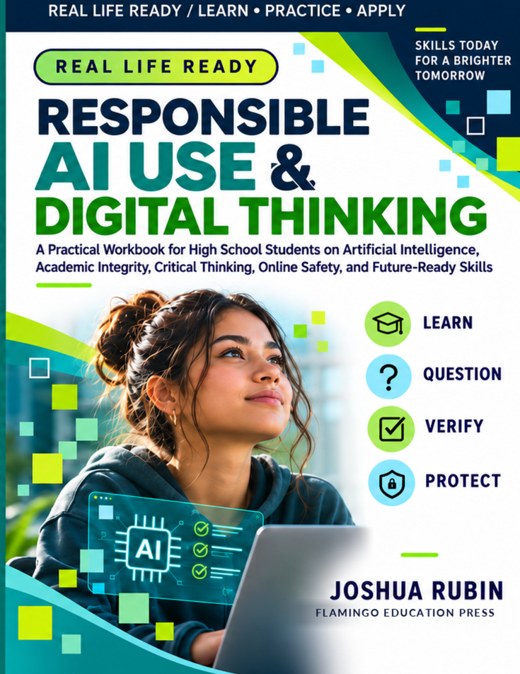
Related Flamingo Education Press resources
These resources may offer useful structured practice or documentation ideas. Review the exact content, availability, and institutional suitability before purchasing.
Educational planning guidance only. Follow your school's current instructional, safeguarding, accessibility, and privacy requirements.